UV DTF Transfer Stickers vs. Traditional Vinyl Labels: Waterproof & Scratch-Resistant Packaging Guide
Labels do more than identify a product. On a crowded shelf or in an unboxing video, they signal whether a brand looks established or temporary. For packaging teams, the practical question is not which label looks best in a catalogue. It is which format survives your surface, your handling process and your shipping environment.
Traditional vinyl labels have been the default for decades. UV DTF transfer stickers are a newer option for short-run, full-colour branding on smooth hard surfaces. They solve a different problem, and understanding that difference prevents costly mistakes.
What traditional vinyl labels do well
A vinyl label is printed on adhesive-backed material and applied directly to the surface. It can be supplied on sheets or rolls, die-cut to a shape, or printed as part of a larger label design.
Strengths
- High-volume efficiency — roll-fed labels can be applied very quickly.
- Predictable formats — standard shapes and sizes are easy to reorder.
- Broad material choice — paper, white vinyl, clear vinyl and specialty stocks.
- Established workflow — most fulfilment teams already understand label application.
For products that need regulatory information, barcodes or variable data, vinyl labels remain hard to replace. The format is familiar to printers, converters and retail teams.
Limitations
Vinyl labels depend heavily on adhesive performance. On curved, textured or low-energy plastic surfaces, edges can lift. Outdoor moisture, abrasion and oil exposure also affect the printed surface and adhesive bond. If the label is applied to a bottle that will be handled repeatedly, edge lift becomes a visible quality problem.
What UV DTF transfer stickers are
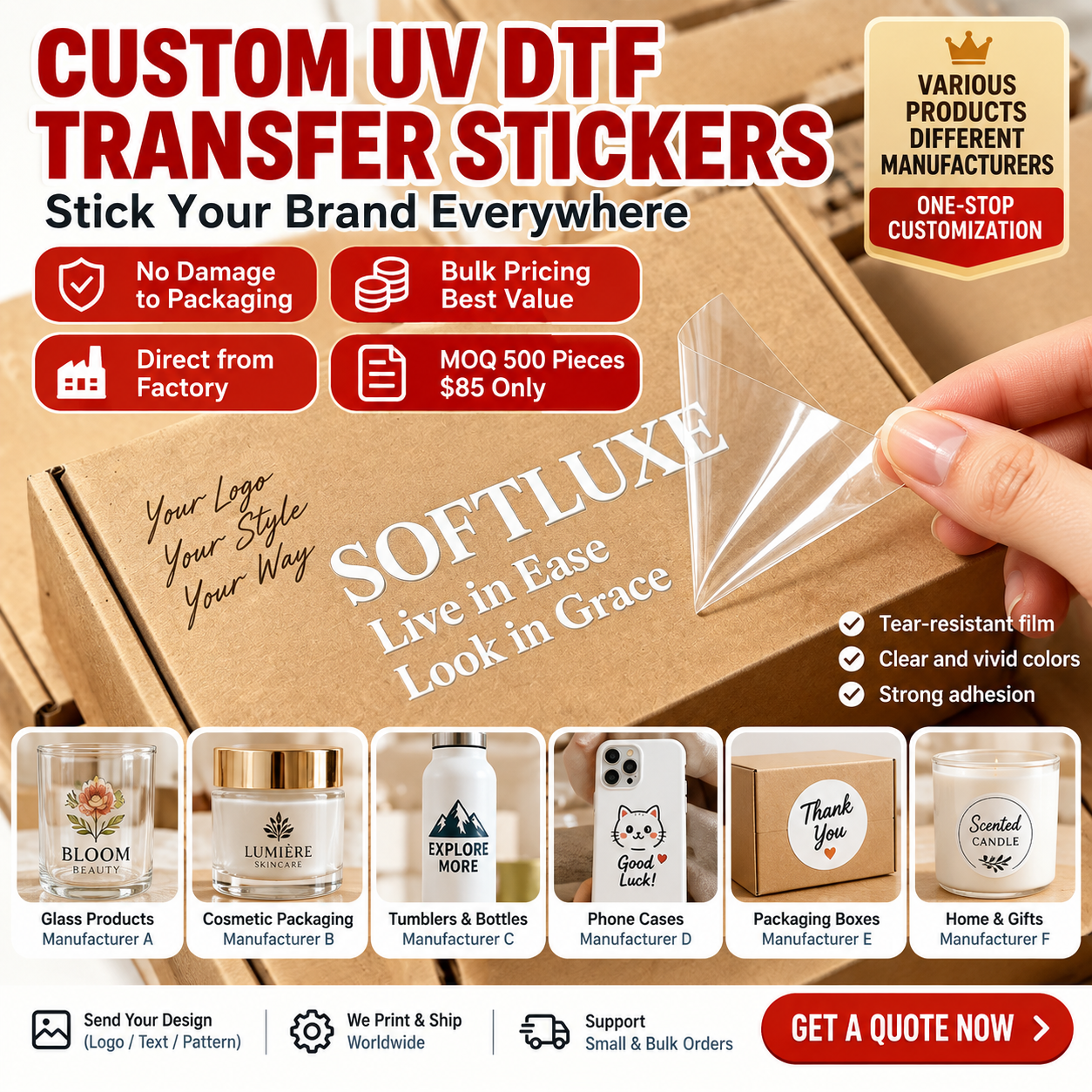
UV DTF is a transfer system. The artwork is printed onto a film, then transferred onto the target surface with a laminate layer. No heat press is required for the application process described in our product listing.
The result sits on the surface as a durable printed design, rather than as a traditional paper or vinyl label with a visible adhesive edge. That makes it attractive for branding on packaging components that do not accept standard labels cleanly.
Typical use cases
- Glass jars and bottles
- Plastic containers and caps
- Acrylic displays and retail holders
- Metal tins and tool cases
- Coated rigid boxes and gift packaging
- Promotional merchandise and branded accessories
Waterproof performance: what to verify
UV DTF transfers are commonly chosen for water-resistant applications, but "waterproof" should never be treated as a universal claim. Performance depends on surface preparation, application pressure, curing time and the environment.
Before committing to a product claim, test the finished application:
- Apply the transfer to a clean, dry surface.
- Allow it to set for the recommended time.
- Test with water exposure, wiping and normal handling.
- Check edges, corners and high-contact areas.
- Repeat after several days, not only immediately after application.
For beverage, cosmetic or outdoor products, also test exposure to oils, alcohols and cleaning agents. A transfer that survives water may still fail against a specific chemical used in your production or shipping environment.
Scratch resistance and handling
The laminate layer in a UV DTF transfer provides a protective surface. This is useful for products that are handled repeatedly or rubbed against other items in a carton. However, scratch resistance is still a system property: the surface hardness, the application quality and the sharpness of neighbouring objects all matter.
If products are shipped loose in a carton, improve internal packing before blaming the label. Abrasion from carton movement can damage any printed surface. For rigid gift boxes, pairing UV DTF branding with a suitable insert or protective sleeve gives more consistent results.
Surface compatibility matters more than material name
A common buying mistake is choosing the label format before testing the surface. Smooth, non-porous materials usually give the best result for UV DTF. Rough, dusty, oily or heavily textured surfaces need careful evaluation.
Good candidates
- Glass
- Smooth plastic
- Acrylic
- Powder-coated metal
- Laminated paperboard
- Coated rigid box surfaces
Candidates that need testing
- Uncoated kraft board
- Textured specialty paper
- Silicone or soft-touch coatings
- Oily or freshly printed surfaces
- Flexible packaging that bends constantly
If your product surface changes between production batches, ask for samples from more than one batch before placing a bulk order.
UV DTF or vinyl: a practical comparison
| Criteria | Traditional vinyl label | UV DTF transfer sticker |
|---|---|---|
| Application | Adhesive label applied directly | Transfer film applied to surface |
| Best for | High-volume standard labelling | Short-run decorative branding |
| Full-colour artwork | Good | Very good |
| Edge visibility | Visible label edge | No traditional label edge |
| Curved surfaces | Good if material conforms | Depends on surface and size |
| Water resistance | Depends on stock and adhesive | Designed for water-resistant use when properly applied |
| Heat press | Usually not needed | Not required for our listed transfer process |
| Typical use | Compliance labels, retail labels | Brand marks, decorative graphics, packaging accents |
Artwork preparation
UV DTF supports detailed full-colour artwork, including gradients and fine typography. That flexibility is useful for brands moving from a simple logo to a more expressive packaging identity.
Before production:
- Supply artwork at final size or higher resolution.
- Keep important text away from the outer trim area.
- Use high-contrast files for small details.
- Confirm whether the white layer is needed under transparent areas.
- Request a proof for colour-critical brand work.
If you do not yet have a finished logo, a free concept generator can help you explore directions before committing to a print run. Our UV DTF listing is $85 per 500 pcs, which is a practical volume for testing several packaging SKUs or launching a small product line.
A low-risk ordering plan
- Define the surface. Record the material, coating and finish of the item receiving the graphic.
- Create or refine the artwork. Use vector files for logos and high-resolution images for illustrations.
- Order a small batch. Test on real packaging, not only on sample cards.
- Run handling tests. Water, rubbing, carton movement and retail handling.
- Check consistency. Compare the first, middle and last pieces in the batch.
- Scale only after approval. Keep the approved artwork and surface specification on file.
Final decision framework
Choose traditional vinyl labels when you need roll-fed efficiency, variable information or a familiar retail label format. Choose UV DTF when you need full-colour decorative branding on smooth hard surfaces, want to avoid a visible label edge, or are producing smaller runs across several SKUs.
Neither option is universally superior. The right choice comes from matching the format to the surface, the production volume and the handling conditions your packaging will actually face.
Test UV DTF branding on your real packaging surfaces
- Custom waterproof, scratch-resistant transfer stickers for glass, plastic and coated packaging
- $85 per 500 pcs — a practical batch for testing several SKUs
- No finished logo yet? Generate concepts first, then preview them on UV stickers
Frequently asked questions
What is the main difference between UV DTF and vinyl labels?
Vinyl labels are die-cut or printed sheets applied directly to a surface. UV DTF uses a transfer film that carries a printed design onto smooth hard surfaces without a heat press.
Are UV DTF stickers waterproof?
UV DTF transfers are designed for water-resistant performance when correctly applied to a compatible smooth surface and allowed to set. Test the finished application in your own conditions before making a product claim.
Can UV DTF replace traditional product labels?
It depends on the production workflow. UV DTF is strong for short runs, decorative branding and hard surfaces. Vinyl remains practical for roll-fed labelling and high-volume standard formats.
What surfaces work best?
Smooth, non-porous surfaces such as glass, plastic, metal, acrylic and coated cartons usually perform best. Rough, oily or heavily textured surfaces need testing before bulk use.
Related products
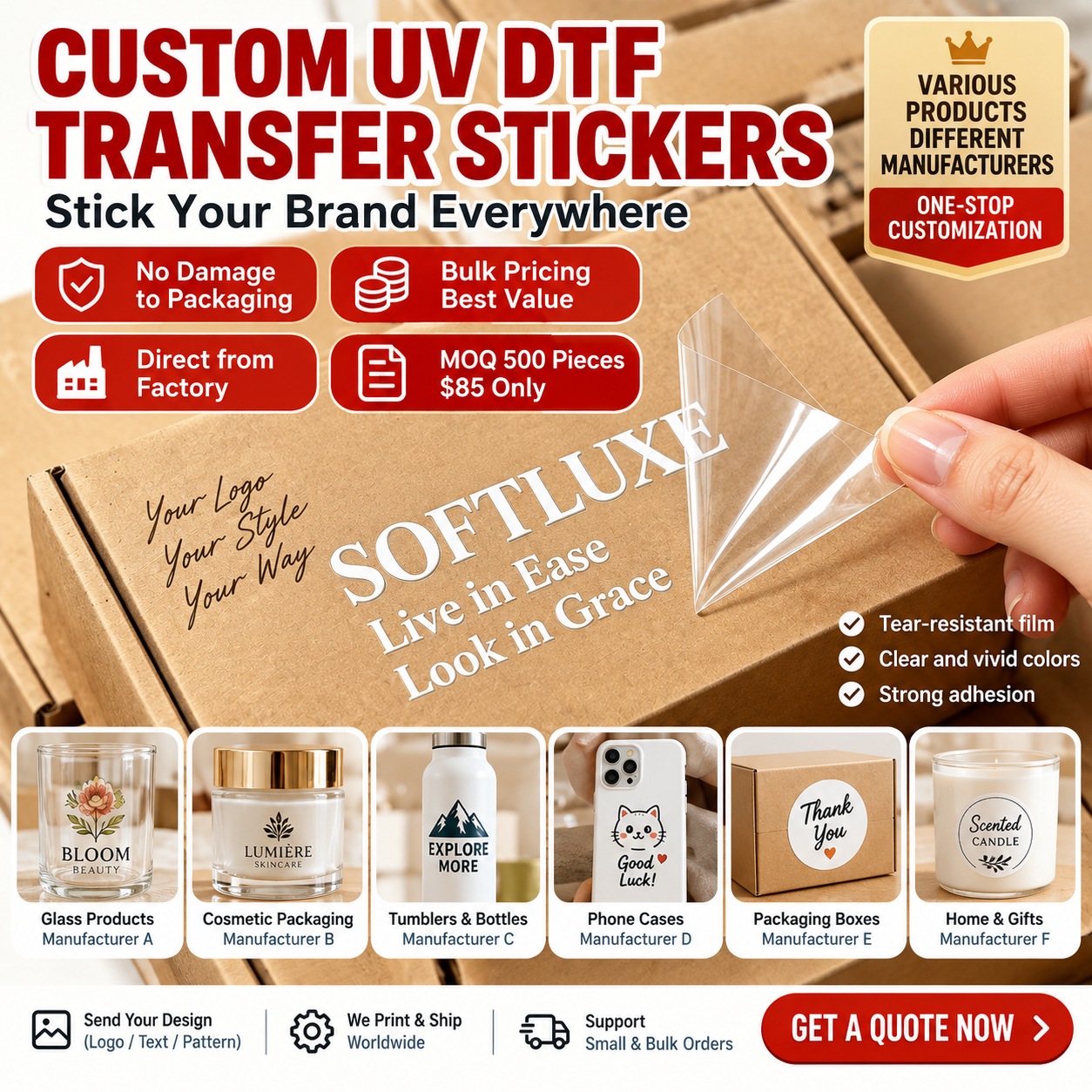
Need protective packaging for your shipments?
Compare options with our team before you commit to a carton size. Share your product dimensions and shipping volume and we will confirm suitability.
Related articles
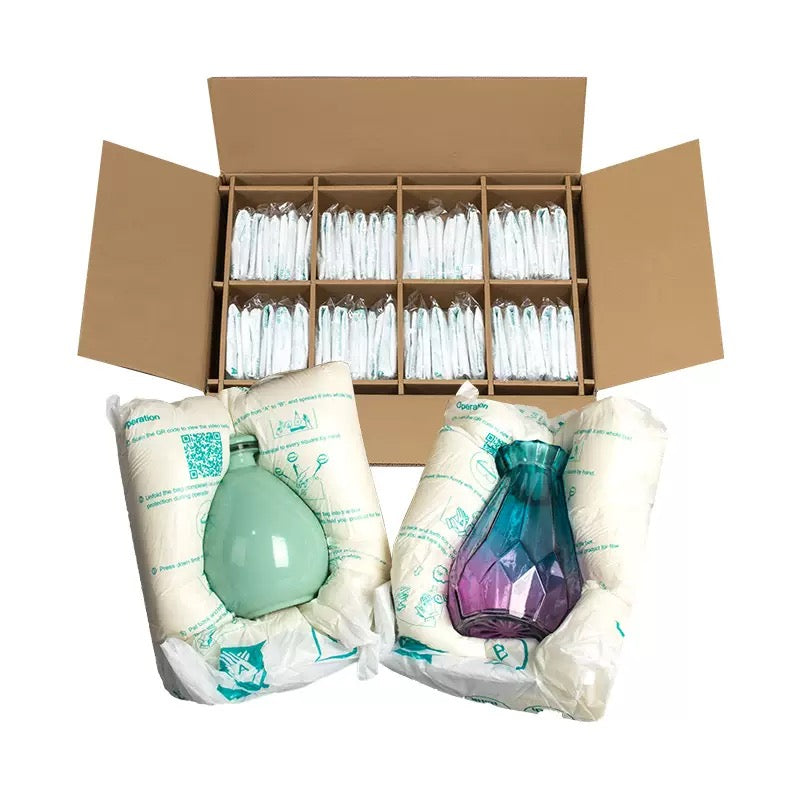
Expanding Foam Packaging Bags vs. Bubble Wrap & Air Pillows: Which Protects Fragile Shipments Better?
A B2B comparison of expanding foam bags, bubble wrap and air pillows for fragile shipments: cushioning behaviour, packing workflow, storage, landed cost and a practical test plan.
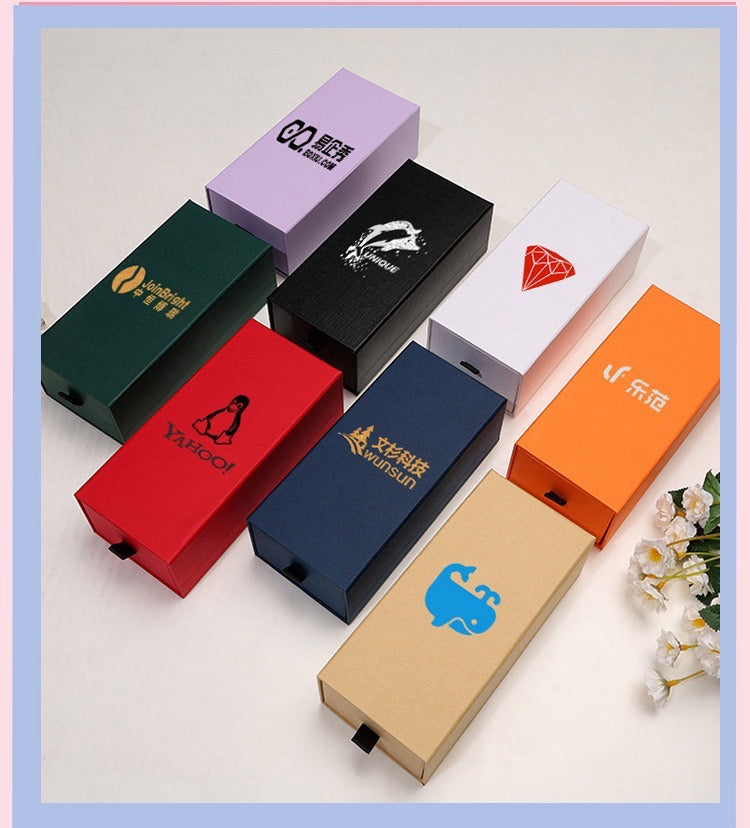
How to Order Custom Luxury Rigid Boxes with Low MOQ (300 pcs) & DDP Shipping to the USA
A practical B2B guide to ordering custom rigid gift boxes with 300 pc low MOQ, artwork preparation, sample approval, DDP shipping to the USA and cost control.